
Home
/
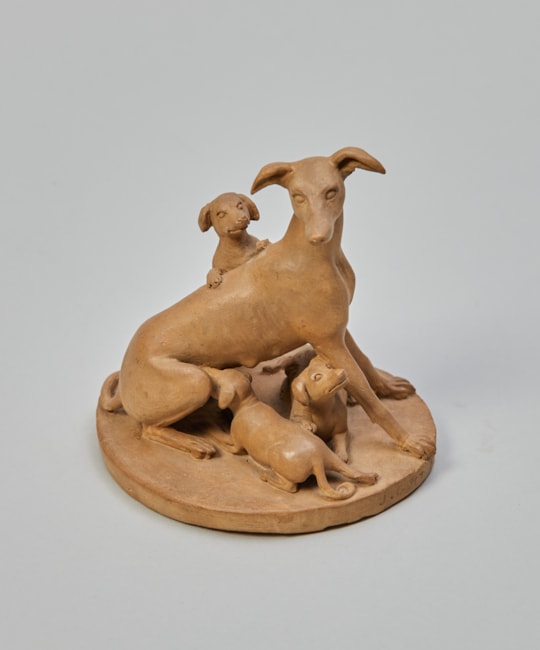
A Sitting Greyhound with her Three Young Puppies
Ref: 2950
Price : 12,000 €
A Sitting Greyhound with her Three Young Puppies
Joseph Gott


Ref: 2950
Price : 12,000 €
A Sitting Greyhound with her Three Young Puppies
Joseph Gott
19th Century
Terracotta
12 x 11.4 x 10.2 cm (4³/₄ x 4¹/₂ inches)
Signed on the oval base: J. Gott FT.
Terracotta
12 x 11.4 x 10.2 cm (4³/₄ x 4¹/₂ inches)
Signed on the oval base: J. Gott FT.
Provenance: Purchased from Phillips, London
A titled member of the clergy, British collection
A titled member of the clergy, British collection
Description: Terracotta Group
Joseph Gott was born in 1785 in Calverley, near Leeds, the son of Benjamin Gott, a wool manufacturer who served as Mayor of Leeds from 1799. Joseph studied under John Flaxman in London from 1798 to 1802 and entered the Royal Academy Schools in 1805, where he won a silver medal in 1806. Around 1822, encouraged and sponsored by Sir Thomas Lawrence, he went to Rome and remained there for the rest of his life, sending works back to Britain for inclusion in the Royal Academy. Rather than the austere Neoclassicism of many of his contemporaries, he chose a more Romantic style. Although he created sculptures on a monumental scale, his most effective works were small groups in terracotta and marble.
In 1823–24, the Duke of Devonshire commissioned Gott to produce a group of "A Greyhound" with her two suckling puppies (Chatsworth House, see Liverpool, Walker Art Gallery, Joseph Gott, 1786–1860, Sculptor, ed. T. Friedman and T. Stevens, 1972, plate 54), completed in 1825.
Joseph Gott was born in 1785 in Calverley, near Leeds, the son of Benjamin Gott, a wool manufacturer who served as Mayor of Leeds from 1799. Joseph studied under John Flaxman in London from 1798 to 1802 and entered the Royal Academy Schools in 1805, where he won a silver medal in 1806. Around 1822, encouraged and sponsored by Sir Thomas Lawrence, he went to Rome and remained there for the rest of his life, sending works back to Britain for inclusion in the Royal Academy. Rather than the austere Neoclassicism of many of his contemporaries, he chose a more Romantic style. Although he created sculptures on a monumental scale, his most effective works were small groups in terracotta and marble.
In 1823–24, the Duke of Devonshire commissioned Gott to produce a group of "A Greyhound" with her two suckling puppies (Chatsworth House, see Liverpool, Walker Art Gallery, Joseph Gott, 1786–1860, Sculptor, ed. T. Friedman and T. Stevens, 1972, plate 54), completed in 1825.
Joseph Gott

Joseph Gott (1786–1860) was a British sculptor whose career joined London training with the classical world of Rome. Born near Leeds, he apprenticed with John Flaxman, entered the Royal Academy Schools in 1805 and, with the support of Sir Thomas Lawrence, settled in Rome in the 1820s. Although rooted in Neoclassicism, Gott’s art often feels warmer and more intimate than austere academic sculpture. He produced portrait busts, funerary monuments, reliefs, classical subjects and especially admired animal and child groups, often in marble or terracotta. Works such as his greyhounds, Bacchic infants and memorial sculptures reveal refined modelling, tender observation and a graceful balance between antiquity and sentiment. Living among Rome’s international artistic community, he served British Grand Tour patrons while developing a distinctive sculptural language. His elegant, polished and classical expressions, were softened by domestic feeling, natural movement and quiet emotional appeal in private and commemorative works within nineteenth-century British taste.
you may also like


A Sitting Greyhound with her Three Young Puppies