
Ref: 3088
Price : 38,000 €
Magnificent Hanau snuffbox with royal blue translucent enamel on a guilloché gold background
Charles et Pierre-Etienne Toussaint


Ref: 3088
Price : 38,000 €
Magnificent Hanau snuffbox with royal blue translucent enamel on a guilloché gold background
Charles et Pierre-Etienne Toussaint
18th Century
1785
Gold and Enamel
1.02 x 0.55 x 0.26 cm (³/₈ x ¹/₄ x ¹/₈ inches)
167g
Imitation of the Paris hallmark for the general leaseholder for Julien Alaterre, December 1768 to September 1775 Cursive crowned K: Imitation of the Paris year/guarantee mark of the Paris maison-commune for 1773-74 Bird's head facing left: Hanau guarantee mark for 19-carat gold (probably imitation of the Paris discharge stamp of Julien Berthe 1750-56) This combination is frequently found on the snuffboxes of the Toussaint brothers until the 1790s.
1785
Gold and Enamel
1.02 x 0.55 x 0.26 cm (³/₈ x ¹/₄ x ¹/₈ inches)
167g
Imitation of the Paris hallmark for the general leaseholder for Julien Alaterre, December 1768 to September 1775 Cursive crowned K: Imitation of the Paris year/guarantee mark of the Paris maison-commune for 1773-74 Bird's head facing left: Hanau guarantee mark for 19-carat gold (probably imitation of the Paris discharge stamp of Julien Berthe 1750-56) This combination is frequently found on the snuffboxes of the Toussaint brothers until the 1790s.
Literature: Lorenz Seelig, “Eighteenth century Hanau gold boxes”, Silver Society of Canada Journal 2015
“Going for Gold – Craftsmanship and Collecting of Gold Boxes”; edited by Tessa Murdoch and Heike Zech; Sussex Academic Press 2014; pp. 74–91 Lorenz Seelig: “Gold Box Production in Hanau”
Seelig, Lorenz; “Gold boxes from the 18th century from the collection of the Princes of Thurn and Taxis” Hirmer Verlag Munich 2008; p. 49
“Going for Gold – Craftsmanship and Collecting of Gold Boxes”; edited by Tessa Murdoch and Heike Zech; Sussex Academic Press 2014; pp. 74–91 Lorenz Seelig: “Gold Box Production in Hanau”
Seelig, Lorenz; “Gold boxes from the 18th century from the collection of the Princes of Thurn and Taxis” Hirmer Verlag Munich 2008; p. 49
Description: Dimensions: 102 × 55 × 26 mm
Weight: 167.0 g
Marks
Crowned LFT maker's mark – Les Frères Toussaint
Flower rosette – Imitation of the Paris charge mark used under the Fermier Général Julien Alaterre, in use from December 1768 to September 1775.
Crowned italic letter K – Imitation of the Paris date/warranty mark of the Maison Commune for the years 1773–1774.
Bird's head facing left – Hanau guarantee mark for 19-carat gold, probably intended as an imitation of the Paris discharge mark used by Julien Berthe (1750–1756).
This combination of marks frequently appears on snuff boxes produced by Les Frères Toussaint well into the 1790s.
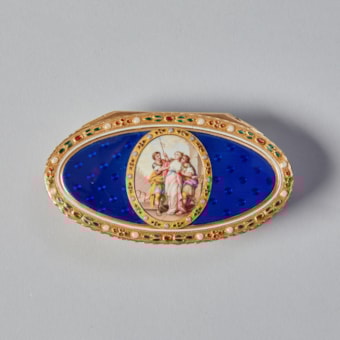
The exceptionally rich royal-blue translucent enamel of this elegant and substantial snuff box is laid over an engine-turned wave pattern enhanced with symmetrically arranged bead-point decoration of outstanding refinement.
As the box is moved in the light, the enamel creates remarkable three-dimensional reflections of extraordinary brilliance and depth—an optical effect encountered on only a very small number of enamel boxes of this quality.
The borders are framed by several rows comprising a total of 630 enamel beads of varying sizes, the larger beads separated by green double-leaf ornaments.
At the centre of the lid is an oval enamel medallion depicting the allegorical figures of Venus and Cupid before the Altar of Love. Venus holds an oval emblem bearing two flaming hearts, symbolically ignited by Cupid with his torch.
Charles and Pierre-Étienne Toussaint
The brothers Charles Toussaint (1720–1790) and Pierre-Étienne Toussaint (1726–1805), descendants of Huguenot refugees, moved from Berlin to Hanau in 1752—the year in which the Hanau jewellers (Bijoutiers) and the local government formally regulated the use of makers' marks—and officially applied for their commercial privileges.
They quickly established a dominant position within Hanau's luxury trades. By 1762, they employed numerous German and foreign craftsmen, among them Jean-Jacques Bury (1728–1785) of Strasbourg, an outstanding chaser (ciseleur) who had established his own workshop in Hanau in 1758. Two of their most trusted journeymen, Johann Friedrich Bold and Jean d'Ours, had received their training in Berlin, while the engraver Paul Scallet, who had spent ten years working in Paris, also came from Berlin.
This illustrates the important role played by the Huguenot-dominated luxury goods industry of Berlin in Hanau's emergence as one of Europe's foremost centres for the manufacture of gold snuff boxes.
The gold boxes bearing the maker's mark LFT were produced by Les Frères Toussaint, the firm's official name. In addition to the maker's mark, their boxes normally bear a gold standard mark—either a bird's head or a shell—struck on the outer rim, precisely where Paris discharge marks were traditionally applied.
The rosette-shaped punch, invariably found adjacent to the LFT mark, was modelled after the Paris discharge mark used between 1768 and 1774. Likewise, the crowned italic letter K, found in conjunction with the LFT mark, was clearly inspired by the Paris inspector's (jurande) mark for the years 1773–1774.
It is highly probable that the Toussaint brothers adopted this distinctive combination of marks—used until the end of the eighteenth century, and possibly It is not yet known whether the Toussaint brothers employed different maker's marks prior to this period. The Metropolitan Museum of Art, New York, preserves two stylistically identical and superbly chased gold snuff boxes, both bearing the same maker's mark. According to the Museum's database, the mark is identified as LFT, although the letter F is not easily discernible. The three letters appear in the same sequence as the LFT mark adopted after 1773 and are likewise surmounted by a crown; however, the overall form differs significantly from that of the later punch.
Identical marks to those found on the New York snuff boxes also occur on several gold boxes produced during the 1760s or early 1770s, which the author has previously attributed to Berlin on stylistic grounds. Since some of these examples also bear the Hanau bird's-head standard mark, a Hanau origin should likewise be considered.
These objects may, in fact, represent early works by the Toussaint brothers, who had originally established themselves in Berlin before relocating to Hanau. Following their move, and with the assistance of craftsmen trained in Berlin, they appear to have produced gold boxes closely modelled on Parisian prototypes of the 1750s.
Consistent with this early date, the third of the three punches—formed as a harrow—imitates the Paris charge mark used between 1756 and 1762, while the first mark, in the form of a bull's head, closely resembles the Paris charge mark employed from 1750 to 1756.
It may therefore be concluded that Hanau was already producing a substantial number of gold snuff boxes from the mid-eighteenth century onwards, some of them displaying distinctly early Neoclassical characteristics. A more progressive stylistic vocabulary emerged following the contract concluded with the Genevan guilloché engraver Étienne Flamant, making it entirely plausible that the Toussaint brothers adopted a new combination of marks around 1773.
Among the earliest creations produced after this date are the gold snuff boxes enamelled with brown moss-agate motifs over an engine-turned wave ground, usually covered with translucent golden-yellow enamel. These examples represent some of the earliest works executed by Les Frères Toussaint under their revised marking system.even later—following the signing of their contract with the Genevan guilloché engraver Étienne Flamant on 15 November 1773.This decorative scheme, first employed around 1775 by the Parisian jeweller Charles Le Bastier, was quickly adopted by the Toussaint brothers in Hanau.
Somewhat more common are the fully enamelled (en plein) LFT gold boxes decorated with seascapes executed en rose camaïeu (in monochrome purple). These compositions were probably inspired by Parisian gold boxes of the late 1770s and typically depict a narrow coastline with ruins in the distance or a solitary ship at sea. As discussed below, the enamel painting can be attributed to the enamel specialist Ignatius Peter (Johann Ignaz) Krafft (1745–1810).
Other gold boxes attributed to the Toussaint brothers display a decorative treatment that appears only from the early 1780s onwards: an engine-turned (guilloché) ground enriched with finely engraved bead-point ornament. This design, which became fashionable in Paris around 1780, was further developed by the Toussaints, who arranged the bead points into four-petalled floral motifs or introduced additional linear bands into the pattern.
In some instances, the bead points were executed in contrasting colours—for example, a deep red set against the green waves of the guilloché ground—creating a particularly striking visual effect.
Equally unusual, and rather more exuberant in appearance, is the vermiculé decoration found on two LFT gold boxes, clearly inspired by the work of the Parisian goldsmiths Joseph-Étienne Blerzy and Jean-Joseph Barrière (master 1763; active until 1793), dating from 1781–1782.
During this period, the Toussaints also frequently embellished their gold boxes with large, closely spaced white enamel beads, again largely following the designs of boxes produced by Blerzy-...to lend their products an opulent, if somewhat ostentatious, appearance. Until relatively recently, gold boxes of this type were generally regarded as characteristic of the so-called "Swiss taste."
In their later production, the Toussaint brothers also employed paillons—small pieces of gold foil fired between two layers of translucent enamel—another technique adopted from contemporary Parisian practice. They likewise embraced the star-pattern ground and the peacock-feather design, both of which were developed in Paris during the 1780s.
An oval snuff box sold at auction in Geneva in 1988 displays a particularly unusual interpretation of the peacock-feather motif.
During the 1790s, the Toussaint brothers produced two exceptional gold boxes, both bearing the LFT maker's mark, demonstrating that they also undertook important commissions for distinguished patrons.
The patron of these two boxes, Prince Carl Anselm von Thurn und Taxis (1733–1805), assembled an outstanding collection of gold boxes at his residence in Regensburg, recorded in an inventory compiled in 1796. The collection is now preserved in the Princely Treasury of Thurn und Taxis in Regensburg, which has formed part of the Bavarian National Museum since 1998.
Most of Prince Carl Anselm's acquisitions were made on his behalf by his valet Adrian Morin (c. 1727–1800), a native of Paris who also operated independently as a dealer in luxury goods in Regensburg. Morin was the brother-in-law of the painter Johan Zoffany (1733–1810), himself a native of Regensburg who later achieved considerable success in London.
Morin's account book, preserved in the Thurn und Taxis Archives, provides—at least in the German context—an unparalleled insight into the activities of a luxury goods dealer during the second half of the eighteenth century.Among the most remarkable objects in Prince Carl Anselm's collection was a large gold snuff box mounted with six Wedgwood plaques depicting scenes from Homer's Iliad and Odyssey. The neoclassical gold mounts bear the LFT maker's mark of Les Frères Toussaint, together with the shell guarantee mark indicating 19-carat gold on the rim.
Morin's account book records that in 1791 he purchased the six Wedgwood plaques at the Frankfurt Fair from Christoph (or Christoffel) Godfried Haagen (1739–1816), a dealer based in The Hague who specialized in English imports. Morin subsequently entrusted the plaques—most probably while still attending the Frankfurt Fair—to the Toussaint brothers, who mounted them in a gold snuff box.
In 1792, Prince Carl Anselm von Thurn und Taxis acquired the completed Wedgwood box from Morin for 870 guilders.
Morin was one of the Toussaints' most important and loyal clients, purchasing substantially more from the brothers than from any other supplier in Hanau. His recorded purchases between 1766 and 1787 alone amounted to the remarkable sum of 104,900 guilders, representing the equivalent value of approximately 100 to 200 high-quality gold snuff boxes.The second box bearing the LFT maker's mark is likewise recorded in the 1796 inventory. Its panels are covered with a layer of translucent dark blue enamel applied over finely engraved gold relief, a technique known as flinqué. The exquisitely engraved scenes from Homer's Odyssey become visible only under certain lighting conditions, demonstrating the remarkable skill of the engravers and chasers whose artistry was fundamental to the production of luxury gold boxes. It also explains why Hanau made such determined efforts to attract and retain the finest craftsmen of the period.
Around 1802–1803, Pierre-Étienne Toussaint's sons, Louis Otto Toussaint (1766–1825) and Charles Jacob Toussaint (1768–1813), assumed control of the luxury goods business trading under the name Les Frères Toussaint.
The traveller Philipp Andreas Nemnich (1764–1822), in his account of a visit to Hanau around 1809, singled out the Toussaint brothers and their guilloché-turning machines manufactured in Hanau as among the city's most noteworthy achievements in the jewellery trade.
Indeed, during 1814–1815, Johann Wolfgang von Goethe, himself a native of nearby Frankfurt, placed the Toussaints at the head of his list of the leading contemporary manufacturers of Hanau's jewellery and luxury goods industry.
The patronage extended to the Toussaint brothers by the Landgraves of Hesse-Kassel provides further evidence of the high esteem in which they were held. The collections of Schloss Fasanerie at Eichenzell, near Fulda, preserve a gold travelling set dating to around 1800, whose spice containers bear the three Les Frères Toussaint marks identical to those found on their gold snuff boxes. (The travelling set also carries a later engraved monogram of Elector William II of Hesse (1777–1847).)
These objects, formerly in the possession of the Landgraves of Hesse-Kassel, provide further compelling evidence that the luxury objects bearing the LFT maker's mark were produced in Hanau, rather than in Geneva, as has occasionally been suggested.
References
Seelig, Lorenz. "Eighteenth-Century Hanau Gold Boxes." Silver Society of Canada Journal, 2015.
Murdoch, Tessa, and Heike Zech (eds.). Going for Gold: Craftsmanship and Collecting of Gold Boxes. Sussex Academic Press, 2014, pp. 74–91. (Lorenz Seelig, "Gold Box Production in Hanau.")
Seelig, Lorenz. Golddosen des 18. Jahrhunderts aus dem Besitz der Fürsten von Thurn und Taxis. Munich: Hirmer Verlag, 2008, p. 49.
Truman, Charles. The Wallace Collection: Catalogue of Gold Boxes. London, 2013, p. 30.
Weight: 167.0 g
Marks
Crowned LFT maker's mark – Les Frères Toussaint
Flower rosette – Imitation of the Paris charge mark used under the Fermier Général Julien Alaterre, in use from December 1768 to September 1775.
Crowned italic letter K – Imitation of the Paris date/warranty mark of the Maison Commune for the years 1773–1774.
Bird's head facing left – Hanau guarantee mark for 19-carat gold, probably intended as an imitation of the Paris discharge mark used by Julien Berthe (1750–1756).
This combination of marks frequently appears on snuff boxes produced by Les Frères Toussaint well into the 1790s.
The exceptionally rich royal-blue translucent enamel of this elegant and substantial snuff box is laid over an engine-turned wave pattern enhanced with symmetrically arranged bead-point decoration of outstanding refinement.
As the box is moved in the light, the enamel creates remarkable three-dimensional reflections of extraordinary brilliance and depth—an optical effect encountered on only a very small number of enamel boxes of this quality.
The borders are framed by several rows comprising a total of 630 enamel beads of varying sizes, the larger beads separated by green double-leaf ornaments.
At the centre of the lid is an oval enamel medallion depicting the allegorical figures of Venus and Cupid before the Altar of Love. Venus holds an oval emblem bearing two flaming hearts, symbolically ignited by Cupid with his torch.
Charles and Pierre-Étienne Toussaint
The brothers Charles Toussaint (1720–1790) and Pierre-Étienne Toussaint (1726–1805), descendants of Huguenot refugees, moved from Berlin to Hanau in 1752—the year in which the Hanau jewellers (Bijoutiers) and the local government formally regulated the use of makers' marks—and officially applied for their commercial privileges.
They quickly established a dominant position within Hanau's luxury trades. By 1762, they employed numerous German and foreign craftsmen, among them Jean-Jacques Bury (1728–1785) of Strasbourg, an outstanding chaser (ciseleur) who had established his own workshop in Hanau in 1758. Two of their most trusted journeymen, Johann Friedrich Bold and Jean d'Ours, had received their training in Berlin, while the engraver Paul Scallet, who had spent ten years working in Paris, also came from Berlin.
This illustrates the important role played by the Huguenot-dominated luxury goods industry of Berlin in Hanau's emergence as one of Europe's foremost centres for the manufacture of gold snuff boxes.
The gold boxes bearing the maker's mark LFT were produced by Les Frères Toussaint, the firm's official name. In addition to the maker's mark, their boxes normally bear a gold standard mark—either a bird's head or a shell—struck on the outer rim, precisely where Paris discharge marks were traditionally applied.
The rosette-shaped punch, invariably found adjacent to the LFT mark, was modelled after the Paris discharge mark used between 1768 and 1774. Likewise, the crowned italic letter K, found in conjunction with the LFT mark, was clearly inspired by the Paris inspector's (jurande) mark for the years 1773–1774.
It is highly probable that the Toussaint brothers adopted this distinctive combination of marks—used until the end of the eighteenth century, and possibly It is not yet known whether the Toussaint brothers employed different maker's marks prior to this period. The Metropolitan Museum of Art, New York, preserves two stylistically identical and superbly chased gold snuff boxes, both bearing the same maker's mark. According to the Museum's database, the mark is identified as LFT, although the letter F is not easily discernible. The three letters appear in the same sequence as the LFT mark adopted after 1773 and are likewise surmounted by a crown; however, the overall form differs significantly from that of the later punch.
Identical marks to those found on the New York snuff boxes also occur on several gold boxes produced during the 1760s or early 1770s, which the author has previously attributed to Berlin on stylistic grounds. Since some of these examples also bear the Hanau bird's-head standard mark, a Hanau origin should likewise be considered.
These objects may, in fact, represent early works by the Toussaint brothers, who had originally established themselves in Berlin before relocating to Hanau. Following their move, and with the assistance of craftsmen trained in Berlin, they appear to have produced gold boxes closely modelled on Parisian prototypes of the 1750s.
Consistent with this early date, the third of the three punches—formed as a harrow—imitates the Paris charge mark used between 1756 and 1762, while the first mark, in the form of a bull's head, closely resembles the Paris charge mark employed from 1750 to 1756.
It may therefore be concluded that Hanau was already producing a substantial number of gold snuff boxes from the mid-eighteenth century onwards, some of them displaying distinctly early Neoclassical characteristics. A more progressive stylistic vocabulary emerged following the contract concluded with the Genevan guilloché engraver Étienne Flamant, making it entirely plausible that the Toussaint brothers adopted a new combination of marks around 1773.
Among the earliest creations produced after this date are the gold snuff boxes enamelled with brown moss-agate motifs over an engine-turned wave ground, usually covered with translucent golden-yellow enamel. These examples represent some of the earliest works executed by Les Frères Toussaint under their revised marking system.even later—following the signing of their contract with the Genevan guilloché engraver Étienne Flamant on 15 November 1773.This decorative scheme, first employed around 1775 by the Parisian jeweller Charles Le Bastier, was quickly adopted by the Toussaint brothers in Hanau.
Somewhat more common are the fully enamelled (en plein) LFT gold boxes decorated with seascapes executed en rose camaïeu (in monochrome purple). These compositions were probably inspired by Parisian gold boxes of the late 1770s and typically depict a narrow coastline with ruins in the distance or a solitary ship at sea. As discussed below, the enamel painting can be attributed to the enamel specialist Ignatius Peter (Johann Ignaz) Krafft (1745–1810).
Other gold boxes attributed to the Toussaint brothers display a decorative treatment that appears only from the early 1780s onwards: an engine-turned (guilloché) ground enriched with finely engraved bead-point ornament. This design, which became fashionable in Paris around 1780, was further developed by the Toussaints, who arranged the bead points into four-petalled floral motifs or introduced additional linear bands into the pattern.
In some instances, the bead points were executed in contrasting colours—for example, a deep red set against the green waves of the guilloché ground—creating a particularly striking visual effect.
Equally unusual, and rather more exuberant in appearance, is the vermiculé decoration found on two LFT gold boxes, clearly inspired by the work of the Parisian goldsmiths Joseph-Étienne Blerzy and Jean-Joseph Barrière (master 1763; active until 1793), dating from 1781–1782.
During this period, the Toussaints also frequently embellished their gold boxes with large, closely spaced white enamel beads, again largely following the designs of boxes produced by Blerzy-...to lend their products an opulent, if somewhat ostentatious, appearance. Until relatively recently, gold boxes of this type were generally regarded as characteristic of the so-called "Swiss taste."
In their later production, the Toussaint brothers also employed paillons—small pieces of gold foil fired between two layers of translucent enamel—another technique adopted from contemporary Parisian practice. They likewise embraced the star-pattern ground and the peacock-feather design, both of which were developed in Paris during the 1780s.
An oval snuff box sold at auction in Geneva in 1988 displays a particularly unusual interpretation of the peacock-feather motif.
During the 1790s, the Toussaint brothers produced two exceptional gold boxes, both bearing the LFT maker's mark, demonstrating that they also undertook important commissions for distinguished patrons.
The patron of these two boxes, Prince Carl Anselm von Thurn und Taxis (1733–1805), assembled an outstanding collection of gold boxes at his residence in Regensburg, recorded in an inventory compiled in 1796. The collection is now preserved in the Princely Treasury of Thurn und Taxis in Regensburg, which has formed part of the Bavarian National Museum since 1998.
Most of Prince Carl Anselm's acquisitions were made on his behalf by his valet Adrian Morin (c. 1727–1800), a native of Paris who also operated independently as a dealer in luxury goods in Regensburg. Morin was the brother-in-law of the painter Johan Zoffany (1733–1810), himself a native of Regensburg who later achieved considerable success in London.
Morin's account book, preserved in the Thurn und Taxis Archives, provides—at least in the German context—an unparalleled insight into the activities of a luxury goods dealer during the second half of the eighteenth century.Among the most remarkable objects in Prince Carl Anselm's collection was a large gold snuff box mounted with six Wedgwood plaques depicting scenes from Homer's Iliad and Odyssey. The neoclassical gold mounts bear the LFT maker's mark of Les Frères Toussaint, together with the shell guarantee mark indicating 19-carat gold on the rim.
Morin's account book records that in 1791 he purchased the six Wedgwood plaques at the Frankfurt Fair from Christoph (or Christoffel) Godfried Haagen (1739–1816), a dealer based in The Hague who specialized in English imports. Morin subsequently entrusted the plaques—most probably while still attending the Frankfurt Fair—to the Toussaint brothers, who mounted them in a gold snuff box.
In 1792, Prince Carl Anselm von Thurn und Taxis acquired the completed Wedgwood box from Morin for 870 guilders.
Morin was one of the Toussaints' most important and loyal clients, purchasing substantially more from the brothers than from any other supplier in Hanau. His recorded purchases between 1766 and 1787 alone amounted to the remarkable sum of 104,900 guilders, representing the equivalent value of approximately 100 to 200 high-quality gold snuff boxes.The second box bearing the LFT maker's mark is likewise recorded in the 1796 inventory. Its panels are covered with a layer of translucent dark blue enamel applied over finely engraved gold relief, a technique known as flinqué. The exquisitely engraved scenes from Homer's Odyssey become visible only under certain lighting conditions, demonstrating the remarkable skill of the engravers and chasers whose artistry was fundamental to the production of luxury gold boxes. It also explains why Hanau made such determined efforts to attract and retain the finest craftsmen of the period.
Around 1802–1803, Pierre-Étienne Toussaint's sons, Louis Otto Toussaint (1766–1825) and Charles Jacob Toussaint (1768–1813), assumed control of the luxury goods business trading under the name Les Frères Toussaint.
The traveller Philipp Andreas Nemnich (1764–1822), in his account of a visit to Hanau around 1809, singled out the Toussaint brothers and their guilloché-turning machines manufactured in Hanau as among the city's most noteworthy achievements in the jewellery trade.
Indeed, during 1814–1815, Johann Wolfgang von Goethe, himself a native of nearby Frankfurt, placed the Toussaints at the head of his list of the leading contemporary manufacturers of Hanau's jewellery and luxury goods industry.
The patronage extended to the Toussaint brothers by the Landgraves of Hesse-Kassel provides further evidence of the high esteem in which they were held. The collections of Schloss Fasanerie at Eichenzell, near Fulda, preserve a gold travelling set dating to around 1800, whose spice containers bear the three Les Frères Toussaint marks identical to those found on their gold snuff boxes. (The travelling set also carries a later engraved monogram of Elector William II of Hesse (1777–1847).)
These objects, formerly in the possession of the Landgraves of Hesse-Kassel, provide further compelling evidence that the luxury objects bearing the LFT maker's mark were produced in Hanau, rather than in Geneva, as has occasionally been suggested.
References
Seelig, Lorenz. "Eighteenth-Century Hanau Gold Boxes." Silver Society of Canada Journal, 2015.
Murdoch, Tessa, and Heike Zech (eds.). Going for Gold: Craftsmanship and Collecting of Gold Boxes. Sussex Academic Press, 2014, pp. 74–91. (Lorenz Seelig, "Gold Box Production in Hanau.")
Seelig, Lorenz. Golddosen des 18. Jahrhunderts aus dem Besitz der Fürsten von Thurn und Taxis. Munich: Hirmer Verlag, 2008, p. 49.
Truman, Charles. The Wallace Collection: Catalogue of Gold Boxes. London, 2013, p. 30.
you may also like


Magnificent Hanau snuffbox with royal blue translucent enamel on a guilloché gold background