
Ref: 2934
Ein Paar Kerzenleuchter mit Amoretten
Johann Joachim Kändler

Ref: 2934
Ein Paar Kerzenleuchter mit Amoretten
Johann Joachim Kändler
18. Jahrhundert
ca 1750
Porzellan
19 cm
Deutschland
ca 1750
Porzellan
19 cm
Deutschland
Provenienz: Privatsammlung Rheinland
Literatur: Zum Modell siehe Bergmann, Sabine und Thomas: Meissener Figuren, Band III.2, Erlangen, 2017, S. 39.
Beschreibung: Ein Paar Kerzenleuchter mit Amoretten
Deutsch, Meißen, um 1750/60
Johann Joachim Kändler (1706 Fischbach/Arnsdorf – 1775 Meißen)
Porzellan, polychrome Bemalung, dezente Goldverzierung, Bronzemontierung, Vincenne-Blüten
Auf einem geschwungenen, leicht erhöhten Rocaille-Sockel steht eine Figur eines Amoretto als Bäcker. Dahinter befindet sich ein schlanker Schaft mit einem Tragering und einer Daumenauflage in Form eines Blattes. Symmetrische Zweige mit Vincenne-Blüten gehen vom Sockel aus. Abschließend eine Tropfschale in Form eines Kleeblattes, zylindrischer Ausguss zwischen drei Akanthusblättern befestigt;
Deutsch, Meißen, um 1750/60
Johann Joachim Kändler (1706 Fischbach/Arnsdorf – 1775 Meißen)
Porzellan, polychrome Bemalung, dezente Goldverzierung, Bronzemontierung, Vincenne-Blüten
Auf einem geschwungenen, leicht erhöhten Rocaille-Sockel steht eine Figur eines Amoretto als Bäcker. Dahinter befindet sich ein schlanker Schaft mit einem Tragering und einer Daumenauflage in Form eines Blattes. Symmetrische Zweige mit Vincenne-Blüten gehen vom Sockel aus. Abschließend eine Tropfschale in Form eines Kleeblattes, zylindrischer Ausguss zwischen drei Akanthusblättern befestigt;
Johann Joachim Kändler

Johann Joachim Kändler (1706–1775) war der einflussreichste Modellierer des Meissener Porzellans und eine zentrale Figur der europäischen dekorativen Künste des 18. Jahrhunderts. Zunächst bei dem Dresdner Hofbildhauer Johann Benjamin Thomae ausgebildet, trat er 1731 in die Meissener Manufaktur ein und wurde bald darauf Chefmodellierer. Kändler verwandelte Porzellan in ein skulpturales Medium und schuf Tiere, Hofgestalten, Figuren der Commedia dell’arte, mythologische Gruppen, Tischdekorationen und ambitionierte Servicen, die technische Kühnheit mit rokokoischem Witz verbanden. Seine Modelle wurden wegen ihrer lebendigen Gestik, ihrer genauen Beobachtungsgabe und ihrer außergewöhnlichen Detailtreue bewundert, von Federn und Fell bis hin zu Theaterkostümen. Sein Meisterwerk, das 1737 für Graf Heinrich von Brühl in Auftrag gegebene Schwanenservice, umfasste mehr als 2.200 Teile und gilt bis heute als eine der größten Errungenschaften Meissens. Im Laufe seiner langen Karriere trug Kändler maßgeblich zur Prägung der Formensprache des europäischen Porzellans bei und beeinflusste Manufakturen von Wien bis Sèvres.
Das könnte Ihnen auch gefallen


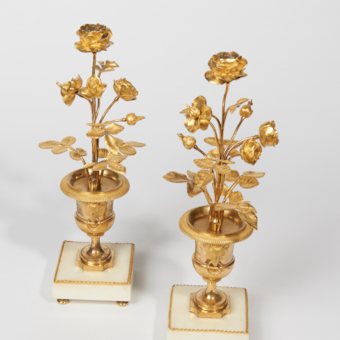


Ein Paar Kerzenleuchter mit Amoretten