
Ref: 1019
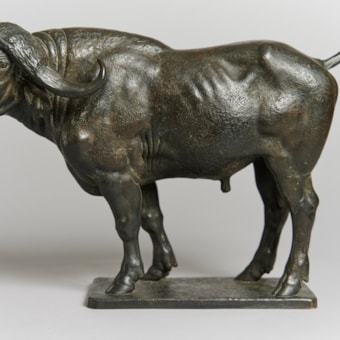
Wisent
Theodor Georgii

Ref: 1019
Wisent
Theodor Georgii
1913
Patinated Bronze
47 x 59 cm (18¹/₂ x 23¹/₄ inches)
Signed and dated Th. Georgii 1913 Foundry signature: C. Leyrer Munich
Patinated Bronze
47 x 59 cm (18¹/₂ x 23¹/₄ inches)
Signed and dated Th. Georgii 1913 Foundry signature: C. Leyrer Munich
Provenance: Collection of Prof. Dr. Josef Albert Amann Jr., Munich
Literature: Catalogue XIV Venice Biennale 1924, "Toro Bavarese"
Hubert Klee, Theodor Georgii, Bruckmann Verlag, Munich 1930, p. 15, described with fig. 7
Sigrid Esche-Braunfels/Vincent Mayr, The Wittelsbach Fountain in Munich: The Restoration of the Stone Thrower after the Second World War by Theodor Georgii, in Schönere Heimat, issue 3/2003
Hubert Klee, Theodor Georgii, Bruckmann Verlag, Munich 1930, p. 15, described with fig. 7
Sigrid Esche-Braunfels/Vincent Mayr, The Wittelsbach Fountain in Munich: The Restoration of the Stone Thrower after the Second World War by Theodor Georgii, in Schönere Heimat, issue 3/2003
Description: Bronze with dark brown patina
on a rectangular, reddish-veined marble base
Theodor Georgii was a German sculptor. He came from a Swabian family. From 1902 to 1903, he studied at the Academy of Fine Arts in Stuttgart under Robert Poetzelberger, in 1904 at the Dillens Art School in Brussels, and in 1905 at the Academy of Fine Arts in Munich under Adolf von Hildebrand, whose daughter Irene he married in 1907. Of Hildebrand's later students, Georgii developed a special mastery of stone sculpture, in keeping with Hildebrand's original demands. Georgii also traveled via Paris and Belgium to join the Hildebrand art circle and began free-carving works from stone, which Hildebrand received with great approval. He was a member of the Secession in Munich. In 1930, Georgii received an appointment at the Vienna School of Applied Arts. In 1946, he returned to Munich and taught at the Academy of Fine Arts, becoming an honorary member in 1953. Georgii initially became known for his animal sculptures, many of which were used to decorate parks. Although their value is unequal when measured by an absolute standard, one thing is evident in all of them without distinction: a true understanding of the world and atmosphere of animals and of the poetry that prevails there. Three works in this field stand out from the others in their quality. They are: the large "Deer" (1907), the "Wisent" (1913), and the "Little Bull" (1924). In these works, he succeeds in fully conveying the poetry of these animals with great precision and in the unique language of sculpture.
on a rectangular, reddish-veined marble base
Theodor Georgii was a German sculptor. He came from a Swabian family. From 1902 to 1903, he studied at the Academy of Fine Arts in Stuttgart under Robert Poetzelberger, in 1904 at the Dillens Art School in Brussels, and in 1905 at the Academy of Fine Arts in Munich under Adolf von Hildebrand, whose daughter Irene he married in 1907. Of Hildebrand's later students, Georgii developed a special mastery of stone sculpture, in keeping with Hildebrand's original demands. Georgii also traveled via Paris and Belgium to join the Hildebrand art circle and began free-carving works from stone, which Hildebrand received with great approval. He was a member of the Secession in Munich. In 1930, Georgii received an appointment at the Vienna School of Applied Arts. In 1946, he returned to Munich and taught at the Academy of Fine Arts, becoming an honorary member in 1953. Georgii initially became known for his animal sculptures, many of which were used to decorate parks. Although their value is unequal when measured by an absolute standard, one thing is evident in all of them without distinction: a true understanding of the world and atmosphere of animals and of the poetry that prevails there. Three works in this field stand out from the others in their quality. They are: the large "Deer" (1907), the "Wisent" (1913), and the "Little Bull" (1924). In these works, he succeeds in fully conveying the poetry of these animals with great precision and in the unique language of sculpture.
Theodor Georgii

Theodor Georgii (1883–1963) was a German sculptor and medallist of the Munich School. Born near Saint Petersburg, he studied in Stuttgart, Brussels and Munich under Adolf von Hildebrand, later marrying Hildebrand’s daughter Irene. His stone figures, portraits, animals and religious works continue Hildebrand’s classical discipline while introducing a quieter, more modern sense of movement and volume.
you may also like


Wisent