
Home
/
The Imperial Prince and his dog Nero
Ref: 2173
The Imperial Prince and his dog Nero
Jean-Baptiste Carpeaux


Ref: 2173
The Imperial Prince and his dog Nero
Jean-Baptiste Carpeaux
The Imperial Prince and his dog Nero
71 x 25 x 27 cm (28 x 9⁷/₈ inches)
Signed on the right side of the plinth: JBTE CARPEAUX TUILERIES 1865
71 x 25 x 27 cm (28 x 9⁷/₈ inches)
Signed on the right side of the plinth: JBTE CARPEAUX TUILERIES 1865
Exhibition: Musée d’Orsay, France, marble version
Literature:
De l'Usage de l'art en politique, Presses univeritaires, Blaise Pascal, p. 122
Michel Poletti et Alain Richarme, Jean-Baptiste Carpeaux sculpteur, catalog raisonné de l’œuvre édité, Paris, 200, pp. 113 – 116 Fig.
De l'Usage de l'art en politique, Presses univeritaires, Blaise Pascal, p. 122
Michel Poletti et Alain Richarme, Jean-Baptiste Carpeaux sculpteur, catalog raisonné de l’œuvre édité, Paris, 200, pp. 113 – 116 Fig.
Description: Jean-Baptiste Carpeaux (Paris 1827 - 1875)
Designed around 1865
Cast: early 20th century
Signed on the right side of the plinth: JBTE CARPEAUX TUILERIES 1865
Signature under the dog's tail: F crowned
Stamped crown on the back of the plinth
Title on the front of the plinth: S. A. LE PRINCE IMPERIAL
Patinated bronze
The only son of Emperor Napoleon III and Empress Eugenie de Montijo is depicted accompanied by the emperor's dog.
The sculptor Jean-Baptiste Carpeaux knew the eight-year-old prince very well and gave him drawing lessons. He had him alternate with another boy, whose suit served as a model for the sculptor. It gives the heir to the empire the natural appearance of a child from the upper classes of the time, but without any imperial attributes or official clothing. The portrait expresses the importance the child now holds within the family. The portrait of the prince is highly sought after and is produced in various sizes, in bronze, plaster, clay, and bisque. Even after the fall of the empire and the tragic death of the imperial prince, who was killed by the Zulus in South Africa in 1879, the Sèvres manufactory continued to sell his portrait under the title Child with Dog.
Designed around 1865
Cast: early 20th century
Signed on the right side of the plinth: JBTE CARPEAUX TUILERIES 1865
Signature under the dog's tail: F crowned
Stamped crown on the back of the plinth
Title on the front of the plinth: S. A. LE PRINCE IMPERIAL
Patinated bronze
The only son of Emperor Napoleon III and Empress Eugenie de Montijo is depicted accompanied by the emperor's dog.
The sculptor Jean-Baptiste Carpeaux knew the eight-year-old prince very well and gave him drawing lessons. He had him alternate with another boy, whose suit served as a model for the sculptor. It gives the heir to the empire the natural appearance of a child from the upper classes of the time, but without any imperial attributes or official clothing. The portrait expresses the importance the child now holds within the family. The portrait of the prince is highly sought after and is produced in various sizes, in bronze, plaster, clay, and bisque. Even after the fall of the empire and the tragic death of the imperial prince, who was killed by the Zulus in South Africa in 1879, the Sèvres manufactory continued to sell his portrait under the title Child with Dog.
Jean-Baptiste Carpeaux

Jean-Baptiste Carpeaux (1827–1875) was a Valenciennes-born French sculptor whose work brought dramatic movement and psychological intensity to Second Empire art. Trained at the École des Beaux-Arts and winner of the Prix de Rome in 1854, he studied in Italy, where Michelangelo and Renaissance sculpture deeply shaped his sense of anatomy and emotion. His group Ugolino and His Sons revealed his taste for tragic tension, twisting bodies and expressive faces.
Carpeaux later became closely associated with Napoleon III’s circle, producing vivid portrait busts and major public commissions. His most famous work, La Danse for the façade of the Paris Opéra, shocked viewers with its sensual energy and naturalism. He also contributed to The Four Parts of the World fountain. Across marble, bronze and architectural sculpture, Carpeaux combined academic skill with restless vitality, making his figures feel unusually alive, theatrical and modern.
Carpeaux later became closely associated with Napoleon III’s circle, producing vivid portrait busts and major public commissions. His most famous work, La Danse for the façade of the Paris Opéra, shocked viewers with its sensual energy and naturalism. He also contributed to The Four Parts of the World fountain. Across marble, bronze and architectural sculpture, Carpeaux combined academic skill with restless vitality, making his figures feel unusually alive, theatrical and modern.
you may also like

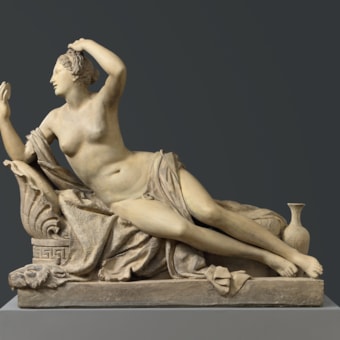


The Imperial Prince and his dog Nero