
Ref: 2597
Price : 45,000 €
Significant Large Mantel Clock La Victoire de la Science


Ref: 2597
Price : 45,000 €
Significant Large Mantel Clock La Victoire de la Science
Paris, period LOUIS XVI
Gilded Bronze
55 x 57 x 17.5 cm (21⁵/₈ x 22¹/₂ inches)
Gilded Bronze
55 x 57 x 17.5 cm (21⁵/₈ x 22¹/₂ inches)
Provenance: Private collection of an Italian noble family
Literature: Tardy, Dictionnaire des Horlogers Francais, Paris 1971
Tardy, French Clocks – The World over, Part Two, Paris 1981
Tardy, La Pendule Francaise, Paris 1974,
Pierre Kjellberg, Encyclopédie de la Pendule Française du Moyen Age au XXe siècle, Paris 1997
Tardy, French Clocks – The World over, Part Two, Paris 1981
Tardy, La Pendule Francaise, Paris 1974,
Pierre Kjellberg, Encyclopédie de la Pendule Française du Moyen Age au XXe siècle, Paris 1997
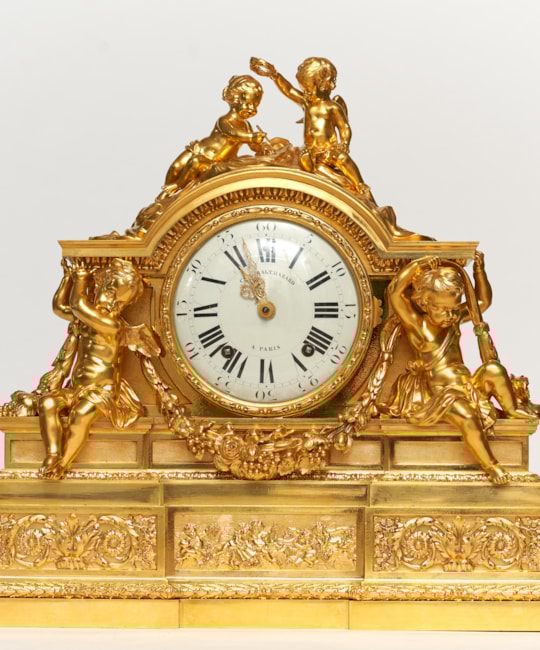
Description: Six putti adorn the case, which is also exquisitely decorated with leaf ornaments and tendrils.
Enameled dial with Roman and Arabic numerals.
Inscribed: Charles Balthazardà Paris
Case attributed to: Jean-Baptiste Osmond, Paris, Master 1764.
Gilded and chased bronze.
Robert Osmond (1711-1789) designed the first "architectural" model—the upper part reminiscent of a pediment—to illustrate the Coronnement de la Science (The Success of Science). Also called Les Enfants de France (The Children of France), it depicts a putto crowning a young girl drawing with a compass. On December 28, 1778, it was delivered to Versailles by Lépine, the king's clockmaker since 1762, for the apartment of Madame Royale, the king's daughter and eldest child, in the Princes' Wing.
Charles-Henri Baltazar received the title of "Clockmaker of the Little Girls of France" in 1717. He settled in the Place Dauphine in 1733, at the Cloister of Saint-Germain de l'Auxerrois in 1737, and in the Rue de Roule in 1747. He was considered one of the most famous clockmakers in his family and supplied movements to prominent cabinetmakers of his time, such as J. Dubois and J. F. Oeben. Baltazar manufactured a large number of clocks and purchased the corresponding watchcases from J.-B. Osmond, B. Lieutaud, J. de Saint-Germain, E. Roy, J. Goyer and others. His prominent clientele included the Garde-Meuble Royal, the Russian Embassy, the Count of Armentières, the Marquis de Saint-Georges and M. Castel.
Enameled dial with Roman and Arabic numerals.
Inscribed: Charles Balthazardà Paris
Case attributed to: Jean-Baptiste Osmond, Paris, Master 1764.
Gilded and chased bronze.
Robert Osmond (1711-1789) designed the first "architectural" model—the upper part reminiscent of a pediment—to illustrate the Coronnement de la Science (The Success of Science). Also called Les Enfants de France (The Children of France), it depicts a putto crowning a young girl drawing with a compass. On December 28, 1778, it was delivered to Versailles by Lépine, the king's clockmaker since 1762, for the apartment of Madame Royale, the king's daughter and eldest child, in the Princes' Wing.
Charles-Henri Baltazar received the title of "Clockmaker of the Little Girls of France" in 1717. He settled in the Place Dauphine in 1733, at the Cloister of Saint-Germain de l'Auxerrois in 1737, and in the Rue de Roule in 1747. He was considered one of the most famous clockmakers in his family and supplied movements to prominent cabinetmakers of his time, such as J. Dubois and J. F. Oeben. Baltazar manufactured a large number of clocks and purchased the corresponding watchcases from J.-B. Osmond, B. Lieutaud, J. de Saint-Germain, E. Roy, J. Goyer and others. His prominent clientele included the Garde-Meuble Royal, the Russian Embassy, the Count of Armentières, the Marquis de Saint-Georges and M. Castel.
you may also like


Significant Large Mantel Clock La Victoire de la Science